
WELCOME BONUS 300%
UP TO €2000 + 100
FREE SPINS
UP TO €2000 + 100
FREE SPINS
Home → Games
Casino games at Rolly Spin
Jacks or Better: Check Payout Table Before Betting
Jacks or Better 9/6 full pay carries an RTP of 99.54% and a house edge of 0.46% when played with optimal strategy. The designation 9/6 means a Full House pays 9 coins and a Flush pays 6 coins per 1 coin staked. That is the most player-friendly common video poker pay table, keeping only 0.46 € per 100 € wagered on average.
The Royal Flush bonus of 4,000 coins requires the maximum bet of 5 coins; at lower stakes the jackpot pays only 800 coins. Standard deviation sits at 4.42, far above the 0.95 of Baccarat Player, so bankroll swings are much wider. A player betting 5 coins per round should expect long dry spells between premium hands.
Lower pay tables change the maths immediately: a 9/5 or 8/6 Jacks or Better version drops RTP below the 99.54% mark. Three of a Kind pays 3, Straight pays 4, and Two Pair pays 2, but only the 9/6 combination delivers the 0.46% house edge. Checking the Full House and Flush lines before the first bet is therefore the single most important step.
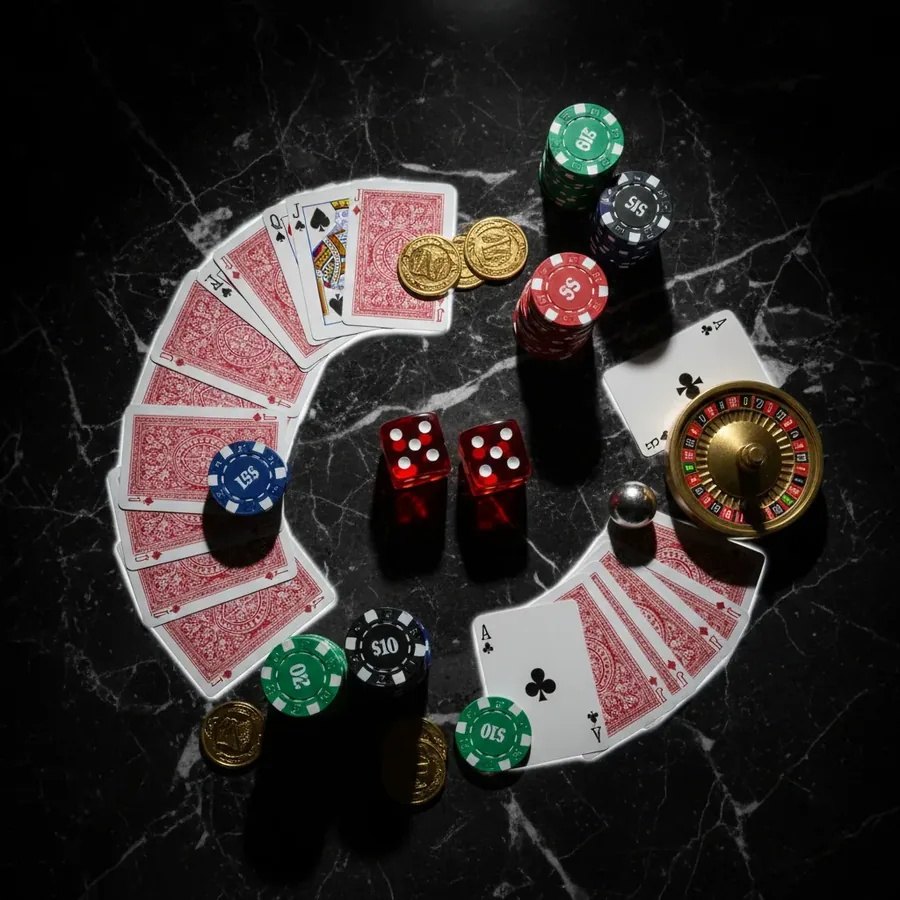
Baccarat in Three Steps: Bet, Reveal, Compare
Baccarat Player on an 8-deck shoe shows an RTP of 98.76% and a house edge of 1.24% with a straight 1:1 payout and no commission. The Banker bet remains better at 98.94% RTP and 1.06% house edge after a 5% commission on wins, a gap of 0.18 percentage points against Player. On 100 € of Player stakes the average cost is 1.24 €.
The first two cards of the chosen side can also trigger the Player Pair or Banker Pair side bet, which pays 11 for 1, effectively 10:1 on the stake. That side bet carries an RTP of only 89.64% and a house edge of 10.36%, an order of magnitude higher than the main game. A 10 € pair bet costs 1.04 € in expected value on average.
The Tie bet with the higher 9:1 payout common online still shows an RTP of 95.16% and a 4.84% house edge, far worse than either Banker or Player. Standard deviation for Player is 0.95 and for Banker 0.93, so both main bets are relatively steady. The three-step flow is simply: place the bet, reveal the cards, compare totals.
The Craps Pass Line in Four Steps
The Pass Line bet in Craps resolves with an RTP of 98.59% and a house edge of 1.41% per resolved bet, or 0.42% per roll. Come carries identical maths. The process starts with the come-out roll: a 7 or 11 wins even money, a 2, 3 or 12 loses, and any other number becomes the point. Standard deviation is 1.00.
Once a point is set, Free Odds can be added on top of the Pass Line at true odds, with zero house edge. In 3-4-5x mode the combined Pass plus odds house edge drops to 0.37%. Point 4 or 10 pays 2:1, point 5 or 9 pays 3:2, and point 6 or 8 pays 6:5 on the odds portion. No other casino bet offers a 0.00% edge.
The per-roll combined figure is 0.111%, while at 1x odds it is 0.251% and at 2x odds 0.180%. A Pass Line bet of 10 € carries an average cost of 0.14 € per resolved bet, but adding the maximum 3-4-5x odds cuts the overall edge on total action. The fourth step is simply the resolution: point repeated wins, a 7 loses.
6 Decks vs 8 Decks: The House Edge Difference
A 6-deck blackjack game with S17, DAS, DOA and a 3:2 payout offers an RTP of 99.54% and a house edge of 0.46% under basic strategy. Moving from 8 decks to 6 decks improves the player by only about 0.02 percentage points, a nearly invisible difference. The far larger effects come from rule changes such as H17 or surrender.
Dealer hitting soft 17 raises the house edge by 0.22 percentage points, while resplitting aces improves it by 0.08 percentage points and doubling after a split by roughly 0.14 percentage points. Compared with those rule modifiers, the 6-deck versus 8-deck choice is almost irrelevant. Six decks instead of eight is worth about 0.02 percentage points to the player.
The Blackjack Liberal Vegas Strip rule set with S17, DAS, resplit and late surrender reaches an RTP of 99.72% and a house edge of 0.28%, the most player-friendly variant listed. That beats the 6-deck basic strategy figure of 99.54% by 0.18 percentage points. On 100 € of blackjack stakes, 0.28% costs 0.28 €, while 0.46% costs 0.46 €.
When to Surrender 16 Against a 10
Late surrender appears only in the Blackjack Liberal Vegas Strip rule set with S17, DAS and resplit, carrying an RTP of 99.72% and a house edge of 0.28%. Surrendering 16 against a dealer 10 is a basic strategy move in specific conditions: when the dealer hits soft 17, a hard 16 should surrender against a 10. Standard deviation for this variant is 1.15.
The 6-deck game with S17, DAS, DOA and no surrender reaches 99.54% RTP and a 0.46% house edge, but without the late surrender option a hard 16 against a 10 must be hit. Blackjack 6:5 payout instead of 3:2 raises the house edge by exactly 1.39 percentage points to 1.85%, far more than any surrender decision. A 10 € blackjack then pays 12 € instead of 15 €.
Insurance against a dealer ace carries a house edge of 7.47% with 6 to 8 decks, and basic strategy always declines it except for card counters at a true count of +3 or higher. Surrender, by contrast, returns half the stake and cuts the loss on a 16 vs 10. The correct order is: check the rule set, then surrender only where late surrender is offered.
Game categories at a glance
| Category | Examples | Stakes From | Highlight |
|---|---|---|---|
| Slots | Jammin' Jars, Reactoonz, Razor Shark | 0.10 EUR | thousands of titles |
| Table games | Roulette, Blackjack, Baccarat | 0.50 EUR | classic rules |
| Live casino | Blaze Roulette, Ultimate Roulette | 0.20 EUR | real dealers |
| Jackpot games | Mega Moolah, Divine Fortune, Age of the Gods | 0.20 EUR | progressive pools |
| Instant games | Aviator, Plinko, Mines | 0.10 EUR | fast rounds |
| Video poker | Jacks or Better, Deuces Wild | 0.25 EUR | strategy based |
Variance at the Table: 1:1 vs 35:1
Video Poker Jacks or Better 9/6 full pay carries an RTP of 99.54% and a house edge of 0.46% under optimal strategy. The standard deviation is 4.42, which reflects the moderate spread between frequent small payouts such as 1:1 for Jacks or Better and the rare Royal Flush at 800 coins. That structure keeps bankroll swings tighter than most slot play while still leaving room for a meaningful top prize.
A straight bet on American Roulette pays 35:1 but covers only one of 38 pockets, producing a house edge of 5.26% and an RTP of 94.74%. The payout is identical to the European wheel, yet the extra double-zero pocket doubles the house edge. Over 100 rounds of 1 € each, the expected loss is 5.26 €, compared with 0.46 € on the full-pay video poker game.
The same 1:1 payout appears in Blackjack with a regular win, but the blackjack itself pays 3:2 in the six-deck S17 rule set with an RTP of 99.54%. That rule set carries a house edge of 0.46%, matching the video poker figure. A player staking 10 € per hand therefore faces an average loss of 0.046 € per hand, while the same stake on a straight roulette number averages 0.526 € lost.
The Craps Odds Bet: 0% House Edge
The Craps Free Odds bet in 3-4-5x mode is the only wager in the casino with zero house edge, paying at true odds once a point is set. The RTP on the odds portion is 100.00%, and the combined RTP with the Pass Line is 99.63%. The combined house edge drops to 0.37%, which is lower than the 1.41% on the Pass Line alone.
The Pass Line bet itself carries an RTP of 98.59% and a house edge of 1.41% per resolved bet, with a per-roll edge of 0.42%. Adding 1x odds lowers the per-roll combined edge to 0.251%, and 2x odds lowers it further to 0.180%. At 3-4-5x odds, the per-roll combined edge reaches 0.111%, which is measured across the total action on both bets.
Odds payouts follow the point number: point 4 or 10 pays 2:1, point 5 or 9 pays 3:2, and point 6 or 8 pays 6:5. Because the casino takes no edge on this portion, the only long-run cost remains the original Pass Line stake. A player placing 10 € on the Pass Line and 30 € in odds on a point of 5 faces an average cost of 0.141 € on the Pass Line and zero on the odds.
Straight-Up Pays 35:1, Split Pays 17:1
A straight bet on American Roulette is listed as 35:1, covering one of 38 pockets that include 1 through 36 plus 0 and 00. The RTP is 94.74% and the house edge is 5.26%, which is double the edge on a European wheel with only one zero. That means a 10 € straight bet returns 350 € when the number hits, but the expected loss per spin is 0.526 €.
A split bet, known as cheval, pays 17:1 and covers two adjacent numbers on the same 38-pocket American wheel. The house edge remains 5.26% and the RTP stays at 94.74%, because the payout is reduced in proportion to the two-pocket coverage. A 10 € split returns 170 € on a hit, while the average loss per spin is unchanged at 0.526 €.
The Five Number Bet on 0, 00, 1, 2 and 3 pays 6:1 and covers 5 of 38 pockets, producing an RTP of 92.11% and a house edge of 7.89%. That is the only bet on the American wheel with an edge above 5.26%, making it a trap bet with no equivalent on the European wheel. A 10 € stake on this bet carries an expected loss of 0.789 € per spin.
Punto Banco: 5% Commission on Banker Wins
The Baccarat Banker bet with 8 decks and a 5% commission on wins carries an RTP of 98.94% and a house edge of 1.06%. The effective payout is 0.95:1, which offsets the Banker's positional advantage when the third card is drawn. That edge makes the Banker the best bet in the game, beating the Player bet by 0.18 percentage points.
The Baccarat Player bet offers a straight 1:1 payout with no commission and an RTP of 98.76%, resulting in a house edge of 1.24%. The standard deviation is 0.95, slightly higher than the 0.93 on Banker. A 10 € Player stake has an expected loss of 0.124 €, while the same 10 € on Banker costs 0.106 € on average.
The Tie bet at 9:1 carries an RTP of 95.16% and a house edge of 4.84%, which is far worse than either main bet. The higher 9:1 payout, common online, cuts the edge from 14.36% almost threefold, but the Tie remains clearly worse. The Player Pair or Banker Pair side bet is even more expensive at 10.36% house edge and an 89.64% RTP, paid as 11 for 1.
35:1 Instead of 36:1: Where the House Edge Comes From
A straight bet on American Roulette pays 35:1 despite the wheel having 38 pockets, which creates the 5.26% house edge. If the payout matched the true odds of 37:1, the casino would keep nothing, but the shortfall of two units on every winning bet produces the margin. The RTP is 94.74%, meaning 100 € staked loses 5.26 € on average.
The same principle appears in the Five Number Bet, where 6:1 is paid for a bet covering 5 of 38 pockets. The true odds are 6.6:1, and the shortfall pushes the house edge to 7.89% and the RTP down to 92.11%. That is the only American Roulette bet with an edge above 5.26%, making it the worst-value option on the layout.
Blackjack shows how payout ratios change the edge differently. Replacing a 3:2 blackjack payout with 6:5 adds exactly 1.39 percentage points to the house edge, moving the RTP from 99.54% for the six-deck S17 game to 98.15%. On a 10 € bet, a blackjack pays 12 € instead of 15 €, which is a direct three-euro reduction on the player's winning hand.
Jacks or Better 9/6: 99.54% RTP
Video Poker Jacks or Better 9/6 (full pay) runs at an RTP of 99.54% with a house edge of 0.46%, where 9/6 means a Full House pays 9 and a Flush pays 6 per 1 coin. The house edge is the average share of each stake the casino keeps, so €100 of stakes costs €0.46 on average. Only the 9/6 pay table reaches this figure; a lower Full House or Flush return raises the cost per €100 staked.
The pay table pays a Royal Flush 800 per coin, a Straight Flush 50, Four of a Kind 25, a Full House 9, a Flush 6, a Straight 4, Three of a Kind 3, Two Pair 2 and Jacks or Better 1. The Royal Flush bonus of 4,000 requires the maximum bet of 5 coins, so the full 800-for-1 rate only applies at that stake. Standard deviation is 4.42, the highest on this page, which means results swing far wider than on Baccarat Player at 0.95.
Step by step: check the pay table for 9 and 6, bet the maximum 5 coins to unlock the 4,000-coin Royal Flush, then follow optimal strategy rather than hunches. Reaching 99.54% depends on that strategy, not on the pay table alone. A player who deviates from it drops below 99.54% even on the same 9/6 machine.
Split, Double, and Surrender: Three Decisions Explained
Doubling after a split improves RTP by about 0.14 percentage points, while resplitting aces adds 0.08 percentage points, and late surrender is part of the liberal Blackjack rule set that reaches an RTP of 99.72%. Doubling means the stake is doubled with one card, and splitting creates up to 4 hands. Each rule change moves the house edge by a fixed amount, so the three decisions together decide the price of the game.
Dealer hitting soft 17 costs 0.22 percentage points, the largest single rule penalty here, against a gain of 0.14 percentage points for doubling after a split and 0.08 percentage points for resplitting aces. A 6-deck shoe instead of 8 decks is worth about 0.02 percentage points. On a €10 bet, a 0.22 percentage point shift is €0.022 per hand on average.
Step by step: after the first two cards, decide whether to double, whether to split a pair, and whether to surrender; late surrender is available in the liberal rule set that pays 3:2 at an RTP of 99.72%. Doubling after a split and resplitting aces both work in the player's favour, while a dealer who hits soft 17 works against it. Replacing 3:2 with 6:5 costs far more than any of these: 1.85% instead of 0.28%.
Straight-Up 35:1 Against 1-in-37 Odds
A straight bet on the European wheel pays 35:1, and the wheel has 37 pockets, so the chance of a single number is 1 in 37 while the payout is set as if there were 36. The gap between 36 and 37 pockets is the house edge of 2.70%, which on €100 of straight bets keeps €2.70 on average. The American wheel adds a double zero and reaches 38 pockets.
American Roulette has 38 pockets (1–36 plus 0 and 00), an RTP of 94.74% and a house edge of 5.26%, almost double the European figure. The payouts stay unchanged: Straight 35:1, Split 17:1, Street 11:1, Corner 8:1, Six Line 5:1, Dozen 2:1, Column 2:1 and Red/Black 1:1. One extra pocket therefore doubles the casino's share per bet.
Step by step: a straight bet covers 1 pocket, a split covers 2, a street 3, a corner 4 and a six line 6, and each payout shrinks as the coverage grows. The Five Number Bet on 0, 00, 1, 2 and 3 pays 6:1 on 5 of 38 pockets, cutting RTP to 92.11% with a house edge of 7.89%, the only American bet above 5.26%. No equivalent exists on the European wheel.
Double Down: Doubling Your Bet After Two Cards
Doubling down on any first two cards is part of the Blackjack 6 decks, S17, DAS, DOA, 3:2 rule set with an RTP of 99.54% and a house edge of 0.46%. The player doubles the stake and receives exactly one more card. Standard deviation of 1.15 sits close to the 1.00 of Craps Pass Line, so the swing per hand stays moderate.
Doubling after a split is worth about 0.14 percentage points of RTP on its own, and the liberal Vegas Strip set with S17, DAS, resplit and late surrender reaches 99.72% with a house edge of 0.28%. That 0.28% is the lowest figure on this page, below the 0.46% of the 6-deck S17 set. On €100 staked, the difference between the two sets is €0.18.
Step by step: receive two cards, decide to double, place a second stake of the same size, then take one card and stand. On a €10 bet the total at risk becomes €20, so a win returns €30 at 1:1 plus the €20 stake, while a loss costs the full €20. Where 6:5 replaces 3:2, a blackjack on €10 pays €12 instead of €15, which costs more than the doubling rule gains.
Columns and Dozens Pay 2:1 in Roulette
A column bet and a dozen bet each pay 2:1 and cover 12 of the 37 pockets on the European wheel, so 12 of 37 outcomes win while the payout assumes 12 of 36. The shortfall is the house edge of 2.70%, and on €100 spread across columns the average cost is €2.70. The straight bet pays far more at 35:1 but covers only 1 pocket.
On the American wheel the same column and dozen bets pay 2:1 but face 38 pockets, so RTP drops to 94.74% and the house edge rises to 5.26%. Every other outside and inside payout is identical: Split 17:1, Street 11:1, Corner 8:1, Six Line 5:1, Red/Black 1:1. The only bet that breaks the pattern is the Five Number Bet at 92.11% with a 7.89% edge.
Step by step: pick a column or a dozen, stake the amount, and the bet wins on any of its 12 numbers; the payout is 2:1, so a €10 stake returns €30 including the stake. Two dozen bets at €10 each cover 24 of 37 pockets for €20 at risk, and the uncovered 13 pockets still carry the 2.70% edge on every spin.
Contact
Live - online chat
Banking









Providers












Rolly Spin 2026